

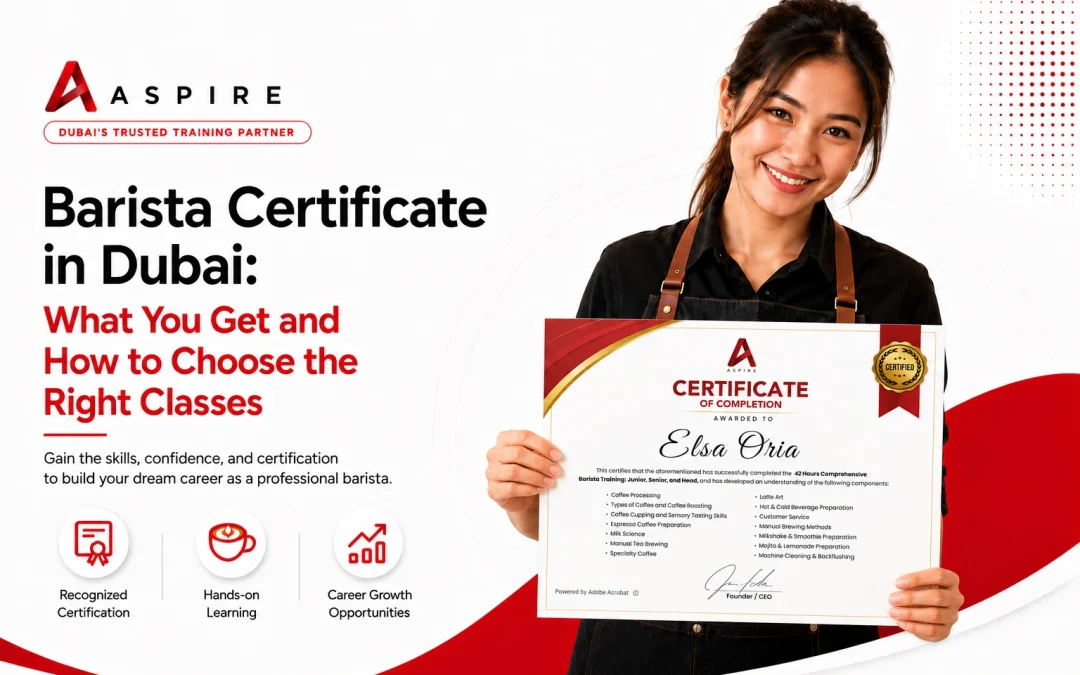
If you want to work as a barista in Dubai, or you just love coffee and want to turn it into a career, a barista certificate is the first step. But many people are not sure what this certificate actually means, what it covers, or how it is different from just watching a few coffee videos online. Dubai’s cafe industry keeps growing every year, and cafes, hotels, and restaurants across the city regularly look for baristas who already know how to use commercial equipment and handle a busy counter. This guide explains what a barista course in dubai gives you, how classes are structured, and how to pick the right course for your goals.
What a Barista Certificate Covers
A proper barista certificate is not just a piece of paper. It confirms that you have practical training in real coffee skills, not just theory. A good barista program usually covers:
- Coffee origins, types, and processing methods
- Espresso machine calibration and extraction
- Milk steaming and latte art
- Brewing methods, including cold brew and specialty drinks
- Coffee machine cleaning and maintenance
- Customer service and cafe workplace basics
At We Aspire, this training is broken into three levels: Junior Barista, Senior Barista, and Head Barista. Each level runs for 14 hours, and the full program is 42 hours across 3 to 4 weeks. You start with the basics, like machine calibration and coffee types, then move into advanced espresso and latte art, and finish with cafe management and business skills. This step by step structure means you are not thrown into advanced techniques before you understand the fundamentals.
By the end of the program, you should be comfortable calibrating an espresso machine, pulling a consistent shot, steaming milk to the right texture, and pouring basic latte art. You also learn how a cafe runs day to day, including hygiene standards, stock handling, and simple customer service, which matters just as much as the coffee itself when you are working a real shift.
Why the Certificate Actually Matters
Some people think any short workshop is the same as a real certificate. It is not. A recognized barista certificate matters for three reasons.
First, it proves your skill level to employers. Cafes and hotels in Dubai receive many applications, and a certificate from a licensed training center helps you stand out from someone who only has casual experience.
Second, it can be a requirement for certain visa or work documentation processes in the UAE, depending on your employer and role. Having an official, attestable certificate avoids problems later.
Third, it gives you real confidence. Training on commercial espresso machines, under a trainer who has worked in the industry, is very different from practicing at home. You learn the habits and speed that cafes actually expect.
Generic Certificate vs We Aspire’s Certificate
Not all barista certificates carry the same weight. Here is the difference between a generic certificate and what We Aspire provides.
Generic or informal certificates often come from short online courses or single-day workshops. They may teach you the basics of making a latte, but they usually have no official accreditation, no hands-on practice on commercial machines, and no recognition from any government body. Employers cannot always verify them.
We Aspire’s barista certificate is different in a few clear ways:
- KHDA accreditation. Our barista certificate is a KHDA-Certified Barista Certificate, attested by the Dubai Government, which means it can also be attested by MOFA for use outside the UAE.
- Real hands-on hours. You get 42 hours of structured training, not a few hours of demonstration. You practice on commercial espresso machines in a real cafe-style training space.
- Experienced trainer. Our lead barista trainer, Ali Rehman, has over 10 years of barista and hospitality experience across Malaysia and the UAE.
- Two documents, not one. Graduates receive both the KHDA-Certified Barista Certificate and a Certificate of Completion in Barista Skills Training from We Aspire Education Support Services LLC.
- Inclusive training. The program welcomes People of Determination, with accessible facilities and personalized support where needed.
This is the kind of detail worth checking before you enroll anywhere. Ask any training center whether their certificate is government accredited, how many hands-on hours you actually get, and who your trainer is.
KHDA vs International Certificate: What Is the Difference
You may also see providers offering an “international barista certificate,” sometimes linked to global coffee bodies. Here is how to think about it.
A KHDA certificate is issued and recognized locally in Dubai and the UAE. It is attested by the Dubai Government and can be verified by employers in the region. This is the standard most local employers look for.
An international certificate is usually tied to a global coffee association’s curriculum and naming. It can be useful if you plan to work outside the UAE, but it does not always carry the same local weight as a KHDA-accredited certificate for jobs inside Dubai.
For most people building a career in Dubai’s cafes, hotels, and restaurants, a KHDA-accredited certificate is the more practical choice, because local employers already trust and recognize it.
Barista Classes in Dubai: Format Options
Barista classes in Dubai are not one size fits all. Before you choose, think about your schedule and how you learn best.
- Weekday classes. Usually run Monday to Friday, good if you have weekends free or are between jobs.
- Weekend classes. Run Saturday and Sunday, ideal if you are currently working or studying on weekdays.
- Custom batch delivery. Some training centers, including We Aspire, can arrange custom timing for groups or companies on request.
Class timing at We Aspire runs from 9:00 AM to 6:00 PM, with sessions of about 2 hours each, 21 sessions in total. All equipment, ingredients, aprons, and course materials are included, so you do not need to buy anything separately before you start.
How to Choose the Best Barista Course in Dubai
With so many training centers advertising themselves as the best barista course in Dubai, use this simple checklist to compare your options:
- Check accreditation. Confirm the certificate is KHDA-approved, not just a generic completion badge.
- Check hands-on hours. Ask exactly how many hours are practical training versus lecture or video content.
- Check the equipment. Training on commercial-grade espresso machines matters more than practicing on a home machine.
- Check the trainer’s background. A trainer with real cafe or hotel experience teaches skills that actually apply on the job.
- Check what documents you receive. Some centers issue only one certificate. Others, like We Aspire, provide both a KHDA certificate and a completion certificate.
- Check flexibility. Look for weekday, weekend, and payment plan options that fit your life.
Comparing training centers this way is a better approach than picking based on price alone. If you want a full comparison of Dubai’s top barista training providers, see our guide here.
Frequently Asked Questions
How do you get a barista certificate?
You get a barista certificate by completing an accredited training program that combines coffee theory with hands-on practice on real espresso machines, followed by an assessment. In Dubai, look for programs approved by KHDA.
How long does a barista certificate last?
A barista certificate itself does not usually expire, since it confirms training you completed, not a license that needs renewal. However, skills can fade without practice, so many baristas continue learning through workshops like latte art courses.
What is a barista certificate called?
In Dubai, the most recognized type is a KHDA-Certified Barista Certificate. You may also see it referred to as a barista training certificate or barista skills certificate, depending on the training provider.
Where do you get a barista certificate in Dubai?
You get one through a licensed training center that offers a structured barista program with hands-on practice, such as We Aspire’s KHDA-approved course. Avoid providers who cannot clearly explain their accreditation or show you the certificate you will actually receive.