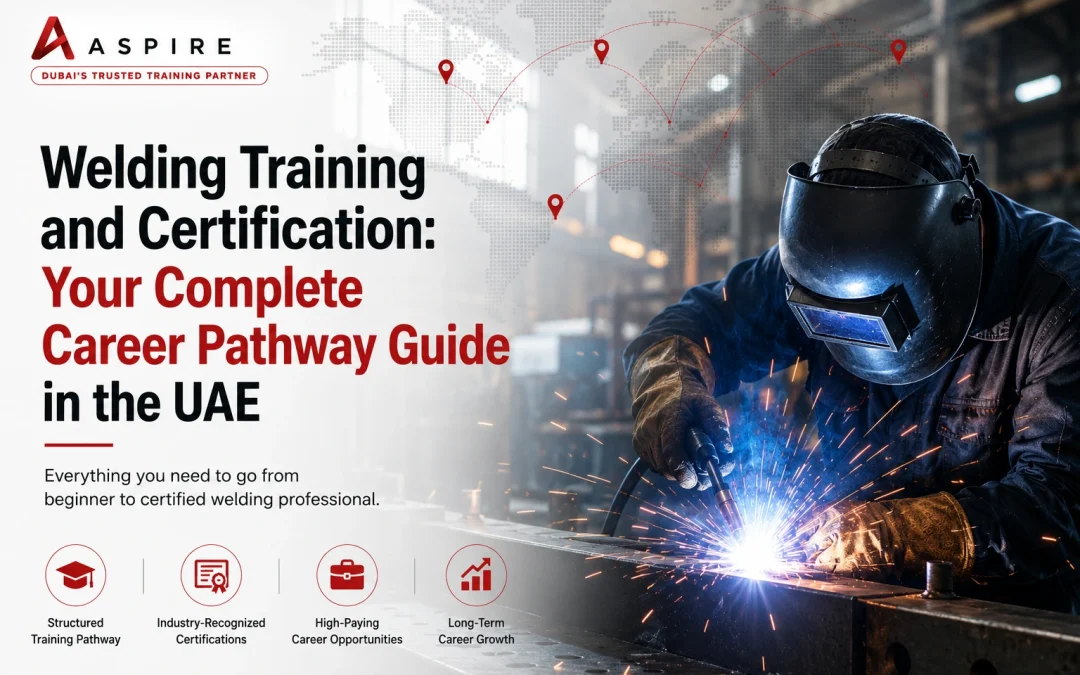
Welding is one of the few technical trades where a few months of structured training can open the door to a genuinely stable, well-paying career. But most people researching welding online run into the same problem: scattered information, confusing certification names, and no clear sense of what actually happens after they finish a course. This guide walks through the full welding training and certification pathway, from your first class to your first certified job, so you know exactly what to expect and what to plan for.
Why Welding Is Worth Considering as a Career
If you have ever asked yourself whether welding is a good career, the honest answer is that it depends less on the trade itself and more on how seriously you approach the training. Welding sits at the center of construction, oil and gas, marine, and manufacturing work across the UAE and the wider Gulf region. These industries do not slow down, and skilled, certified welders are consistently in demand because the work cannot be automated away easily. A welder who invests in proper training and recognized certification is not just learning a manual skill. They are building a credential that employers actively search for, which is very different from a job that anyone can walk into without preparation.
Unlike many careers that require years of formal education, welding offers a shorter and more direct route from training to paid work. That does not mean it is easy. It means the return on your time is faster, provided the training you choose actually prepares you for real industry standards rather than just teaching you to strike an arc.
The Welding Training Pathway: From Beginner to Certified Professional
A proper welding training pathway usually moves through three stages: foundational skills, process specialization, and certification.
At the foundational stage, you learn the basics of metal behavior, safety practices, joint types, and how to read a welding symbol. From there, most training programs introduce you to the core welding processes used across UAE industry:
- Shielded Metal Arc Welding (SMAW), often called stick welding, which is widely used in structural and pipe work because it performs well outdoors and on thicker materials.
- Gas Metal Arc Welding (GMAW), known as MIG welding, favored in manufacturing and fabrication for its speed and cleaner finish.
- Gas Tungsten Arc Welding (GTAW), or TIG welding, the process most associated with precision work on stainless steel, aluminum, and pipe, and one of the highest paying specializations once certified.
Choosing which process to specialize in early matters, because employers in the UAE tend to hire against a specific process rather than a general welding background. Someone trained specifically in TIG welding for pressure piping, for example, is a much easier hire for an oil and gas contractor than someone with only general classroom exposure.
Training courses typically run from a few weeks for foundational classes to several months for combined training and certification programs, depending on how much hands on practice and process coverage is included.
Welding Certification Roadmap: CSWIP, AWS and API 577 Explained
Training teaches you to weld. Certification proves it, and in most cases certification is what actually gets you hired. These are separate certifications taken after training. Our courses are SMAW, GMAW (MIG) and GTAW (TIG) only.
The certification most searched for in this space, by a wide margin, is CSWIP, short for the Certification Scheme for Welding and Inspection Personnel. CSWIP is issued by
TWI Certification Ltd, and it is one of the most recognized welding inspection qualifications in the world, particularly across oil and gas and power generation projects in the Gulf. CSWIP has multiple levels, starting with a Visual Welding Inspector qualification and progressing to Welding Inspector (3.1) and Senior Welding Inspector (3.2). This is not an entry level welder certificate. It is aimed at people moving from hands on welding into inspection and quality roles, which is exactly why it tends to lead to higher paying positions.
Alongside CSWIP, two other credentials come up regularly for anyone mapping out a serious welding career:
- AWS Certified Welder, issued under American Welding Society standards, widely recognized in structural and fabrication work and often requested by contractors following American codes.
- API 577, a certification focused specifically on welding inspection within petroleum and petrochemical industry standards, relevant if your career goal is oil and gas inspection work.
A practical way to think about this roadmap: start with process specific training and a foundational welding certificate, gain hands on site experience, then pursue an inspection level certification such as CSWIP once you have enough practical background to qualify. Trying to jump straight into inspector level certification without welding experience behind you rarely works, since these programs are designed for people who already understand welding from the shop floor up.
Career Growth After Certification: Salary, Positions and Industries Hiring
Once training and certification are in place, the career paths split in a few clear directions.
Entry level certified welders typically move into fabrication shops, construction sites, or manufacturing lines, working under a specific process certification such as SMAW or GMAW. From there, experience and additional certification open up better paying and more specialized roles, including pipe welder, structural welder, and eventually welding supervisor.
For those who pursue inspection certifications like CSWIP, the career path shifts from hands on welding to quality control and compliance, roles such as welding inspector or quality control coordinator, which generally carry higher salaries and more stable, office adjacent working conditions compared to site level welding.
Specialized niches also carry a strong salary premium. TIG welders working on stainless steel or aluminum, pipeline welders certified for high pressure systems, and underwater welders in marine and offshore work all sit above general welding pay because the required skill and certification bar is higher.
In terms of industries actively hiring in the UAE, four sectors consistently stand out:
- Construction, for structural steel and general fabrication welding.
- Oil and gas, where CSWIP and API certifications carry the most weight.
- Marine and shipbuilding, which regularly needs both general welders and specialized underwater welders.
- Manufacturing, particularly for MIG and TIG certified welders in production environments.
The common thread across all of these is that certification, not just raw welding ability, is what determines which door opens next.
Why Proper Training Makes the Difference
None of the certifications above are shortcuts. CSWIP, AWS, and API programs all assume you already have real welding competence behind you, which means the quality of your initial training directly affects whether you are even eligible to pursue them later.
This is where a lot of people lose time without realizing it. Training that only covers the basics without proper hands on practice on real equipment leaves you underprepared when it comes to actual site work or certification exams. A structured welding training program that combines process specific instruction, supervised practical hours, and a clear route toward recognized certification is what actually moves someone from beginner to employable, certified welder in the shortest realistic timeframe. It is the difference between learning to weld and building a career around it.
Start Your Welding Career with We Aspire
If you are serious about building a welding career rather than just picking up a basic skill, the training path you start with matters. We Aspire’s
welding training courses are structured around the same processes and certification routes covered in this guide, SMAW, GMAW, and GTAW, with a focus on preparing students for real industry requirements rather than just classroom theory. Explore the course options above to find the training path that matches the career direction you are aiming for.
Frequently Asked Questions
Is welding a good job in the UAE?
Yes, particularly for anyone who completes recognized process training and certification. Construction, oil and gas, marine, and manufacturing all hire welders consistently, and demand tends to stay steady even when other industries slow down.
Is welding a good career for the future?
Welding remains difficult to automate for most industrial applications, and certified welders, especially those with inspection level credentials like CSWIP, continue to be in demand across the region.
Is welding a high paying job?
Pay varies significantly by specialization and certification level. General welding roles offer steady income, while TIG welding, pipeline welding, and inspection roles tied to certifications such as CSWIP typically pay noticeably more.
What is the highest paid welding job?
Inspection and supervisory roles, such as senior welding inspector positions built on CSWIP certification, along with specialized underwater and pipeline welding, tend to sit at the top of the pay scale.
Is welding and fabrication a good career?
Yes. Fabrication work is one of the most consistent entry points into the welding trade and pairs well with MIG or TIG process training, making it a practical starting point before moving into more specialized roles.
Is welding inspector a good career?
It is one of the stronger long term paths in this field. Moving from hands on welding into inspection through a certification like CSWIP generally means better pay, more stable working conditions, and a clear route toward senior technical roles.